Today I want to talk a little bit
about storytelling and narrative in non-traditional mediums. Specifically, in
computer and video games.
I’ve been an avid gamer since being introduced to a
PlayStation back in the late 90s and am currently part of a 6 console
household, with myself and my hubby owning a PS2, Nintendo Wii, Xbox 360,
PlayStation 4, a Nintendo DS and a Nintendo 3DS between us. That’s three
generations of consoles represented (four if you count the backwards
compatibility of the PS2 that allows it to play original PlayStation games) and
it’s really interesting to note the different attitudes towards storytelling
and narrative drive between the older games and those now appearing on the
newer console iterations.
 Back in the day, when I first became
aware of computers and computer games, the medium was still relatively basic.
Console classics such as Sonic The Hedgehog and Super Mario Bros were massively
popular but most console titles didn’t really go in for narrative. I mean, does
anyone really understand why Bowser keeps kidnapping Princess Peach? And, more
importantly, does anyone really care? I think it’s fair to say most people
didn’t play Mario for the story. If you wanted a game with a little more
narrative depth, you had to look to your computer; long the home of text-based
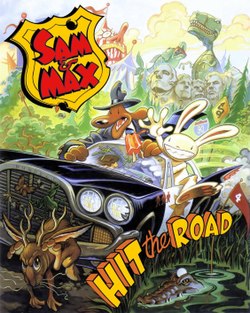
narrative titles and point-and-click adventures such as Broken Sword, Sam and Max Hit the Road (pictured right, with artwork by Steve Purcell) and The Day of the Tentacle.
Back in the day, when I first became
aware of computers and computer games, the medium was still relatively basic.
Console classics such as Sonic The Hedgehog and Super Mario Bros were massively
popular but most console titles didn’t really go in for narrative. I mean, does
anyone really understand why Bowser keeps kidnapping Princess Peach? And, more
importantly, does anyone really care? I think it’s fair to say most people
didn’t play Mario for the story. If you wanted a game with a little more
narrative depth, you had to look to your computer; long the home of text-based
narrative titles and point-and-click adventures such as Broken Sword, Sam and Max Hit the Road (pictured right, with artwork by Steve Purcell) and The Day of the Tentacle.
As consoles developed and became
capable of more complex games, it’s surprising of how the focus remained
largely on gameplay as opposed to story. I was, and remain, a huge fan of TombRaider II but I can’t say that I was driven to play it by the plot which, if I
remember correctly, revolves around a magical dagger that can turn people into
dragons (yes, really). And I love the Resident Evil franchise but I’d be the
first to admit that story isn’t one of its strong points and efforts to
introduce a complex narrative in more recent titles has led the series so far
down the rabbit hole that it’s struggling to retain its fan base. You play
Resident Evil to shoot zombies in the head is all I’m saying.
 Admittedly, there were exceptions
to the rule. J-RPGs such as the Final Fantasy series (pictured left) have been telling amazing,
complicated and often downright weird stories for many years. And The Legend of Zelda and Metal Gear series' have both put serious investment into their
story arcs over the years. But I can definitely see why critics and
storytellers stuck their noses up at computer games and saw them as a less complicated
narrative form.
Admittedly, there were exceptions
to the rule. J-RPGs such as the Final Fantasy series (pictured left) have been telling amazing,
complicated and often downright weird stories for many years. And The Legend of Zelda and Metal Gear series' have both put serious investment into their
story arcs over the years. But I can definitely see why critics and
storytellers stuck their noses up at computer games and saw them as a less complicated
narrative form.  All of that has changed in recent
years, particularly in the most recent console generation. The game that
prompted this post is a curious recent release by developers The Chinese Room called Everybody’s Gone to the Rapture (pictured right), part of a new breed of games known as ‘walking simulators’ (although I
prefer ‘interactive narrative, which seems less dismissive) in which the player
is placed in an extremely pretty environment and left to explore, with story
emerging as you do so.
All of that has changed in recent
years, particularly in the most recent console generation. The game that
prompted this post is a curious recent release by developers The Chinese Room called Everybody’s Gone to the Rapture (pictured right), part of a new breed of games known as ‘walking simulators’ (although I
prefer ‘interactive narrative, which seems less dismissive) in which the player
is placed in an extremely pretty environment and left to explore, with story
emerging as you do so.  Everybody’s Gone to the Rapture takes place in the 1970s
in a sleepy English country village where everybody seems to have disappeared,
leaving in their wake a mysterious trail of light that encourages you to follow
it. The game is unashamedly influenced by classic British sci-fi and playing it
led me to the work of John Wyndham, specifically to ‘The Midwich Cuckoos’, his
classic tale of aliens in our midst set in, you guessed it, a sleepy English
village. In all my long history of playing games and reading books this is the
first time that a game has ever led me to a book and, importantly, that the
narrative of that game has lived up to the narrative of a book which is very
similar in both tone and theme. ‘The Midwich Cuckoos’ is an excellent book and
Everybody’s Gone to the Rapture is an excellent game. Both of them tell their
stories in quietly sinister, creeping way and you get a sense of mounting
horror as you progress through both. In short, both are excellent stories.
Everybody’s Gone to the Rapture takes place in the 1970s
in a sleepy English country village where everybody seems to have disappeared,
leaving in their wake a mysterious trail of light that encourages you to follow
it. The game is unashamedly influenced by classic British sci-fi and playing it
led me to the work of John Wyndham, specifically to ‘The Midwich Cuckoos’, his
classic tale of aliens in our midst set in, you guessed it, a sleepy English
village. In all my long history of playing games and reading books this is the
first time that a game has ever led me to a book and, importantly, that the
narrative of that game has lived up to the narrative of a book which is very
similar in both tone and theme. ‘The Midwich Cuckoos’ is an excellent book and
Everybody’s Gone to the Rapture is an excellent game. Both of them tell their
stories in quietly sinister, creeping way and you get a sense of mounting
horror as you progress through both. In short, both are excellent stories. It is possible to argue that
walking simulators are not really games. Many gamers see them more as
interactive stories and it is true that there is little agency or player
directive in Everybody’s Gone to the Rapture. But, in recent years, there have
been a wealth of games that offer similar narrative depth with more traditional
gameplay mechanics. The Bioshock series (pictured right) is almost as famous for its deeply
involved, extremely complicated lore (which has definite Lovecraftian
overtures) as it is for its immense enemies and cool plasmids. The recently
re-booted Tomb Raider franchise has a story written by Rhianna Pratchett, which
sees Lara Croft develop relationships with other characters and places real
emotional force behind your dealings with both them and with her. Even
previously gung-ho titles such as first-person shooter series Call of Duty have
realised that it pays to have some decent story elements in your single player
campaign if you want to encourage people to actually play it.
It is possible to argue that
walking simulators are not really games. Many gamers see them more as
interactive stories and it is true that there is little agency or player
directive in Everybody’s Gone to the Rapture. But, in recent years, there have
been a wealth of games that offer similar narrative depth with more traditional
gameplay mechanics. The Bioshock series (pictured right) is almost as famous for its deeply
involved, extremely complicated lore (which has definite Lovecraftian
overtures) as it is for its immense enemies and cool plasmids. The recently
re-booted Tomb Raider franchise has a story written by Rhianna Pratchett, which
sees Lara Croft develop relationships with other characters and places real
emotional force behind your dealings with both them and with her. Even
previously gung-ho titles such as first-person shooter series Call of Duty have
realised that it pays to have some decent story elements in your single player
campaign if you want to encourage people to actually play it.
Games media and pre-release
information increasingly focuses on the story as much as it does on the
graphics and the gameplay. Developers have realised that a good story helps
fans to invest emotionally in the world and that, in turn, encourages them to
spend more time in it and to play more games and, hopefully, to buy the next
one. Divergent story arcs, dialogue choices and multiple endings, once the
preserve only of specialist RPGs, have become the norm across so many games
that, to be lauded for your storytelling, developers now have to really push
the boat out. I’m not going to say that storytelling in games is as developed
as that in a novel or book series just yet because it’s definitely not. But
games certainly aren’t cases of style over narrative substance any more. There
are some fantastic stories out there just waiting to be discovered and,
hopefully, many more still to come.
Do you agree that games have become
more narrative driven? Do you see interactive narratives as possible
competitors to traditional mediums? Or is a book a book and a game a game and
never the twain shall meet? I’d be interested to know your thoughts so drop me
a comment down below, tweet me @amyinstaffs or find me on Goodreads!